


A cult beauty brand is not built by chasing attention.
It is built by earning devotion.
The brands people ask for by name, recommend without prompting and return to long after the launch campaign has ended are almost always rooted in something deeper than product performance alone. They have a clear point of view. A distinct emotional world. A reason to exist that feels specific enough to belong to them and no one else.
This guide is for beauty and wellness founders who want to build that kind of brand.
It draws on our work as a beauty brand agency: brands we created from a blank page, brands we refreshed at an inflection point, and brands we repositioned to change the way their category behaves.
The through line is strategy.
The beauty brands that earn devoted followings are built on a clear understanding of who they are, who they serve and why they matter, long before anyone chooses a color, draws a logo or designs a bottle.
Three of our projects anchor this guide. Each represents a different founder situation.
One of them will probably feel familiar.
The beauty consumer has changed the way she decides.
A generation ago, a brand could win on formulation claims, advertising spend and counter placement. Today, the purchase is social before it is personal.
A product is discovered in a friend’s routine, a stylist’s chair, a practitioner’s recommendation or a creator’s video. The formulation may spark interest, but the brand behind it is evaluated just as closely.
That evaluation goes deeper than aesthetics.
Consumers read ingredient lists. They look up founders. They notice whether a brand’s story holds together across its website, packaging, retail presence and social feed. A skincare brand built on clinical credibility is measured against the credibility of the people behind it. A wellness brand promising transparency is judged by how clearly it communicates.
Beauty consumers do not simply buy products anymore.
They decide which brands deserve a place in their lives.
That is why loyalty now looks less like repeat purchase and more like membership. People adopt the brand’s language. They gift it. They defend it in comment sections. They recommend it as though they are sharing part of their own identity.
The beauty brands that earn that level of devotion share one defining quality:
They stand for something specific, and every touchpoint agrees on what that is.
For founders, the implication is clear. Brand deserves the same rigor as formulation, and it deserves it just as early.
The strongest brands are designed as complete systems: strategy, story, identity, packaging, digital experience and community, all expressing one central idea.
That is the work a wellness branding agency or beauty brand partner should be doing with you.
And it begins well before design.
We have written elsewhere about the craft of luxury skincare packaging design. But beautiful craft only becomes meaningful when strategy gives it a reason to exist.
Every brand we build begins with strategy.
It earns its place every time.
Beauty brand strategy is the discipline of answering four questions before the creative work begins:
Who is this for?
What does the category already say?
Where is the whitespace?
What is the one story only this brand can tell?
The audience question goes far beyond demographics.
“Women aged 25 to 45 interested in skincare” is not an audience insight. It is a statistical description.
A meaningful audience definition gets closer to the tension underneath the purchase.
It might be a customer who wants clinical results but distrusts clinical coldness. Someone who values natural ingredients but rejects the visual clichés of natural beauty. A consumer who wants luxury, but not distance. Expertise, but not intimidation.
That distinction is the difference between a generic beauty brand and one that feels as though it was made for someone specific.
The category and whitespace questions require equal honesty.
Beauty is crowded.
Clean claims, minimalist packaging and founder-led storytelling are everywhere. None of them differentiates a brand simply by being present.
Whitespace mapping identifies the positions competitors have left open. Just as importantly, it identifies the positions a brand can credibly own based on what is actually true about it.
That truth becomes the story.
The strongest beauty brands are built on something real: a founder’s expertise, a genuine provenance, a proprietary method or a conviction about how the category should work.
Strategy finds that truth.
Positioning sharpens it.
Messaging gives it language.
Design gives it a world people can enter.
When identity, packaging, digital experience and campaign all flow from the same strategic idea, the brand feels inevitable rather than assembled.
We have explored how this comes to life at the craft level in our guide to luxury packaging design. The strategy described here is what gives that craft its meaning.
The three case studies that follow show the same discipline applied to three very different founder situations.
Tatcha represents the first founder situation: building a brand from nothing and aiming it at the highest level of the market.
We partnered with the founder to create the brand’s strategy, positioning, naming, identity, marketing, packaging and digital experience, building the brand from the ground up and launching it into the top tier of luxury skincare.
The strategic challenge was credibility.
Tatcha began with a single product: authentic Japanese aburatorigami facial beauty papers. The brand’s positioning was inspired by Japanese beauty rituals.
In luxury beauty branding, heritage is powerful precisely because it cannot be fabricated.
It has to be earned.
Consumers can feel the difference between a story borrowed for effect and one built from real provenance. A sourced heritage compounds over time because every new product has somewhere meaningful to come from.
So the heritage was sourced.
Insights were gathered from the Geisha themselves. Formulations were inspired by a 200-year-old Japanese beauty book. That provenance was then paired with enthusiastic endorsements from celebrity makeup artists, giving the emerging brand third-party validation while its own reputation took shape.
The ambition was to create a brand where ancient met modern.
A brand capable of attracting A-list actors, celebrities, beauty editors, bloggers and consumers around the world without diluting the cultural foundation that made it compelling.
The brand expression carries that same tension.
It bridges wisdom and science, heritage and modernity, product and ritual.
The visual world draws from the simple elegance of nature and the rich textures of Kyoto: purple dusk, grey cobblestones, gold leaf. A distinctive watercolor illustration style unifies photography, illustration and Tatcha’s signature purple, placing Japanese heritage within a contemporary luxury context.
From the outside, Tatcha feels effortless.
That is the point.
But effortless brands are rarely built effortlessly.
A credible heritage position requires research, discernment and restraint. Real provenance. A founder with conviction. And trusted voices willing to validate the promise before the broader market has had time to do so.
Heritage cannot simply be asserted.
It has to be made believable at every touchpoint.
You can explore the full scope of the work in our Tatcha Branding case study.
DIME represents the second founder situation, and for many founders, the most familiar one:
A brand that grew quickly and now needs to grow up without losing what made people care.
DIME came to us at a turning point.
The founders had built a multimillion-dollar clean beauty business with viral cross-category products and cult-like loyalty. But much of that momentum depended on influencer partnerships and discount-driven sales.
That model had created growth.
It had not yet created full brand independence.
With ambitions to expand into broader retail channels and grow market share, DIME needed a brand that could do more than ride trends. It had to carry its own gravity.
Influencer reach and promotions can create demand, but a retail buyer evaluates something different.
They ask whether the brand is distinct enough to pull a customer toward the shelf without a discount code attached.
That required strategy.
We began with a deep exploration of audience, category and whitespace, uncovering the insights that would shape the next phase of growth.
From there, we built a brand story and messaging platform around DIME’s most credible source of authority: its master esthetician-founded credentials.
Those credentials had always been present.
The strategy work moved them from the background to the center of the brand, giving consumers a reason to believe that had nothing to do with a promotion.
The result was a stronger foundation for trust and a more meaningful emotional connection with the audience.
We then brought the strategy to life through a refreshed visual identity that balances luxury with approachability, supported by comprehensive guidelines designed for scale.

That last part matters more than it sounds.
A brand entering retail is no longer controlled by a small founding team. It is interpreted by buyers, marketers, retail partners, content teams and production vendors across multiple channels.
Guidelines built for scale are what protect coherence when many hands begin touching the brand.
Growth creates distance between the founder and the final expression.
A strong system closes that distance.
You can see the full project in our DIME case study.
Hairstory represents the third founder situation:
The brand whose product genuinely breaks category convention, and whose branding must be bold enough to do the same.
We positioned Hairstory as a creatively fearless challenger, deliberately zagging against a traditional haircare category.
The strategic decision that shaped everything else was a shift in what the brand would hero.
Rather than building the brand around individual products, we encouraged Hairstory to become a champion for a new way of thinking about haircare.
A brand defined by its stance, not by a single SKU.
That stance needed a specific audience to carry it forward.
For Hairstory, that audience was hairdressers.
Professionals work quickly. They handle products all day. They understand performance in a way consumers may not. And they recommend the brands that respect their craft.
So the identity was built around their reality.
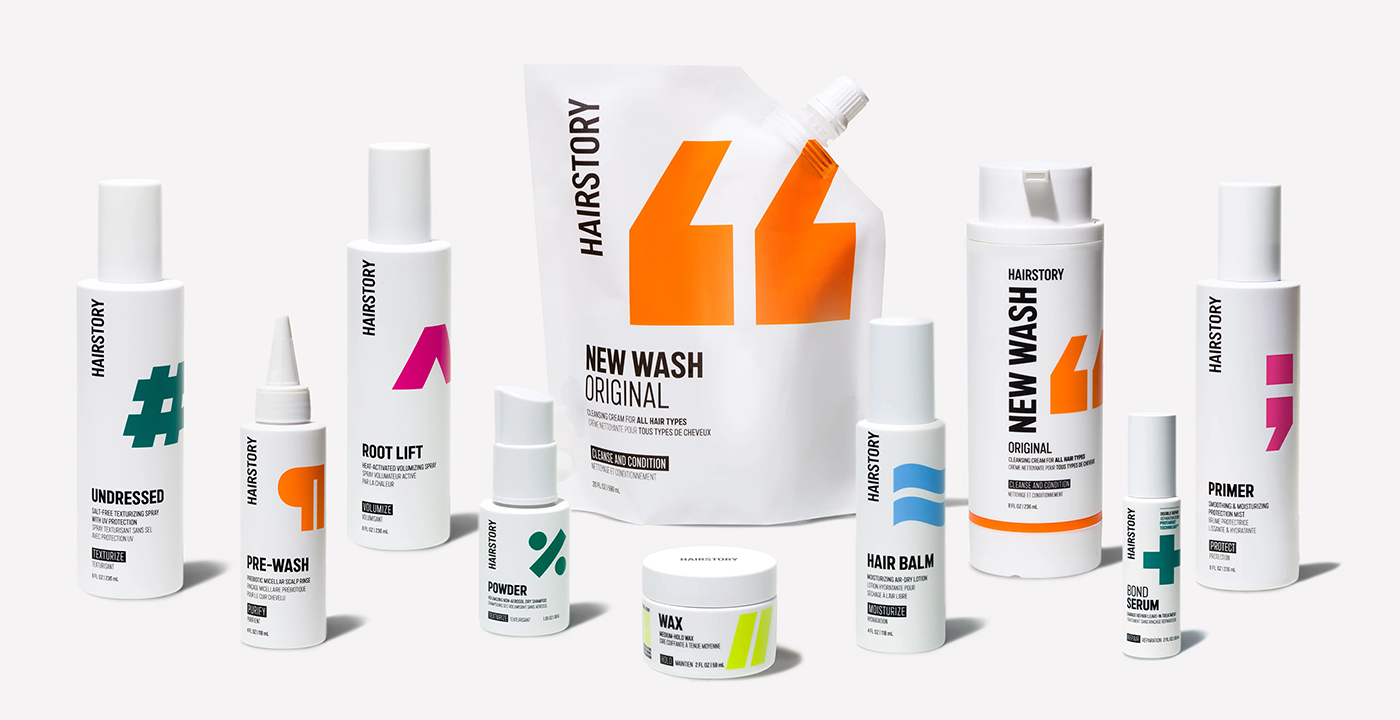
A consistent logotype creates recognition. Vibrant product-specific color coding supports speed and navigation. A clear visual hierarchy makes the system easy to read at a glance.
The strategy extends into the products themselves through custom bottle forms optimized for function and a system of symbols designed to invite storytelling.
Each element gives hairdressers and clients a shared language for talking about the brand.
That is how a challenger position spreads.
Professionals understand it.
They explain it.
Clients repeat it.
A movement begins to form around a point of view.
Challenger brands succeed when conviction is real and execution is disciplined.
Hairstory had the conviction.
The brand work gave that conviction a visual and verbal language bold enough to signal difference, and systematic enough to survive daily professional use.
You can explore the project in our Hairstory case study.
Three brands. Three starting points.
Built from nothing into heritage luxury.
Refreshed to scale into retail.
Repositioned to challenge a category.
You can explore these projects and more in our beauty portfolio.
See Our Beauty Brand Portfolio → Tether Beauty
Founders often ask where new beauty brands go wrong.
In our experience, the brands that thrive tend to make the same five decisions early.
So rather than framing these as failures, we think of them as five things to get right from the beginning.
The strongest brands we have built all began with positioning, audience insight and whitespace mapping.
Design executed against a clear strategy becomes stronger with every touchpoint.
Design executed against a vague one has to be reinvented once the brand finally understands who it is.
A logo cannot compensate for an unclear idea.
Tatcha’s heritage was researched at the source.
DIME’s story is rooted in the founder’s master esthetician credentials.
The strongest brands have something real beneath the story: expertise, provenance, a distinctive method or a conviction the founder has earned the right to hold.
Beauty consumers scrutinize.
Truth gives the brand somewhere stable to stand.
Identity, packaging, messaging, digital experience and community should all express one central idea.
When every piece is briefed separately, the seams show.
When they are created together, each touchpoint makes the others more believable.
Consumers may never articulate that coherence.
They feel it.
DIME’s refresh was designed for the retail expansion ahead of it, with guidelines built for scale.
The channel shapes the brand.
A Sephora shelf, a salon backbar, a practitioner’s office and a direct-to-consumer website each place different demands on packaging, hierarchy, storytelling and navigation.
Deciding early where the brand needs to live prevents expensive compromises later.
Design for the business you are becoming.
Hairstory’s identity was built for hairdressers because their advocacy moves the brand.
Every strong beauty brand has a first audience whose endorsement carries disproportionate influence.
It may be a practitioner. A stylist. An esthetician. A makeup artist. A founder community. A highly specific consumer who sees herself in the brand before anyone else does.
Name that audience.
Understand what earns their trust.
Build for them with intent.
Book a Beauty Strategy Session → Contact us
Choosing a beauty brand agency is not simply a question of taste.
It is a question of judgment.
You are looking for a partner who can see the brand that exists today, understand the business it needs to become and create the strategic and creative system that connects the two.
Start with strategy depth you can verify.
A strong cosmetics branding agency should be able to explain how it arrived at the positioning, not simply show you the finished visual identity.
Ask how they map audience, category and whitespace.
Ask what they learned.
Ask how one specific strategic insight changed one specific design decision.
The answer will tell you whether strategy shaped the work or was written afterward to explain it.
Look for range across founder situations.
Building from a blank page requires a different kind of judgment from refreshing a successful brand or repositioning a challenger.
The right partner understands the difference.
They know when to preserve equity, when to sharpen it and when to leave it behind.
Look for work that extends beyond identity into the complete brand system: naming, packaging, messaging, digital experience and guidelines capable of holding the brand together as it grows.
Beauty brands live at the touchpoint level.
A partner designing the whole system will make choices that reinforce one another rather than compete.
Finally, look for chemistry with rigor.
The best brand work comes from partnership.
We experienced that with Tatcha from its earliest days. The founder brought conviction, cultural insight and product vision. We brought strategic discipline, creative direction and craft.
Neither side could have produced the same result alone.
You bring the belief.
The agency helps make it visible, ownable and impossible to mistake for anyone else’s.
A cult following is not a marketing tactic.
It is the outcome of building a brand on something true, expressing it as one coherent system and aiming it at the people whose devotion matters most.
Tatcha, DIME and Hairstory each began from a different place.
One needed to establish credibility from nothing.
One needed to evolve beyond the growth model that had made it successful.
One needed a brand bold enough to match the conviction of the product.
Each earned loyalty by becoming more specific, not more broad.
That is the paradox at the heart of every cult beauty brand.
The more clearly you define who you are, the more deeply the right people can see themselves in you.
If you are building or rebuilding a beauty brand and want a partner who starts with strategy, reach out, we would love to hear what you are creating.
Share » the » story


