


Sports product design delivers in crucial equipment moments so athletes, trainers and teams can concentrate on performance. A bottle has to grip right. A cooler has to open fast. Sideline gear has to move, hold up and feel natural in the rhythm of play.
At Tether, we design those moments so the product feels intuitive, durable and ready for the real world. That means balancing ergonomics, materials, mechanics, manufacturing and brand expression from the beginning, not treating them as separate steps along the way.
For sports brands, the best products do more than perform. They become part of the culture of the game.
Sports product design is the development of physical equipment and accessories that support athletes before, during and after performance. It can include hydration systems, sideline equipment, recovery tools, training accessories, carriers, dispensers and other products that live around the athlete and the team.
These products often look simple because they have to be simple to use. But beneath that simplicity is a series of design decisions: how the product is held, opened, carried, cleaned, filled, stored, transported, branded and manufactured.
A sport bottle, for example, is not just a container. It is a grip, a valve, a cap, a squeeze system, a cleaning challenge, a brand touchpoint and a piece of equipment that may be used hundreds of times in demanding environments. A sideline cooler is not just an insulated box. It is a refill station, a team ritual, a piece of brand theater and a product that needs to survive transport, weather, impact and repeated use.
That is where industrial design, mechanical thinking and brand strategy start to overlap. The product has to work physically, but it also has to feel appropriate for the athlete, the sport and the brand behind it.
Athletes rarely use equipment in ideal conditions. They are tired, distracted, gloved, wet, rushed or moving between moments of intense focus. Trainers and support staff are often working just as quickly, moving equipment, refilling stations, managing sidelines and keeping teams ready.
That context changes the design brief.
For Tether, this is where the work starts: understanding the actual moment of use. We look at who is using the product, what else is happening around them, what they are holding, how much attention they can give it, and what needs to happen before, during and after that interaction.
In sports product design, “ergonomics” is not just a buzz word, it affects the confidence, control and trust for repeated use. If the athlete or trainer don’t believe in it, the product is discarded.
In sport bottle design, the grip area is not just a styling move. It influences how easily the bottle can be held, squeezed, passed, cleaned and stored. The shape needs to accommodate different hand sizes, different grip positions and different use cases without making the product feel overdesigned.
The same is true across ergonomic sports equipment more broadly — the entire ecosystem of sport has to be considered; how does all the supportive equipment interact together? How does the environment of the sideline impact the equipment’s functionality? Handles, latches, spigots and lids all need to be designed around motion. Who is carrying the product? Are they wearing gloves? Are they moving fast? Are they lifting it into a cart, onto a bench or over a teammate’s head after a win?
Those questions may sound practical, but they are also brand questions. Authenticity is the core. When a product works naturally in a high-pressure moment, the brand earns trust. When it feels awkward, fragile or slow, the brand experience suffers.
That is why prototyping and field-testing matter. Prototypes reveal how a product behaves in the hand, on the sideline and in motion. The best design solutions come from observing the athletic environment. Watching where athletes or trainers hesitate, struggle or have created one-off solutions in unexpected ways. Observation is the foundation to any successful sports product solution.
Material choice is not a finish applied at the end of the process. It shapes the whole product: how it flexes, seals, insulates, cleans, wears, ships and feels in the hand.
A flexible squeeze bottle, an insulated stainless steel bottle and a hard-sided cooler each require a different structural approach. The material affects wall thickness, weight, durability, thermal behavior, texture, manufacturing method and cost. Squeeze bottle design and stainless steel bottle design pull in different directions — one is tuned for flex and recovery, the other for insulation and durability. Change the material and the design often has to change with it.
That is why industrial design and mechanical development need to work together early. A form that looks strong in a rendering still has to survive prototyping, tooling, production and use. A detail that feels elegant on screen has to be manufacturable at scale. A brand expression that looks premium on day one has to hold up after a season of handling, washing, transport and weather.
Good sports product design connects these decisions from the start. The object, the use case, the brand and the manufacturing reality all have to move together.
Gatorade Gx was designed around a powerful idea: personalized hydration for athletes across different sports, routines and performance needs.
The challenge was not simply to create a new bottle. The product had to support a broader hydration platform, integrating the bottle, concentrated formula pods and the moment of mixing into one clear, intuitive experience.
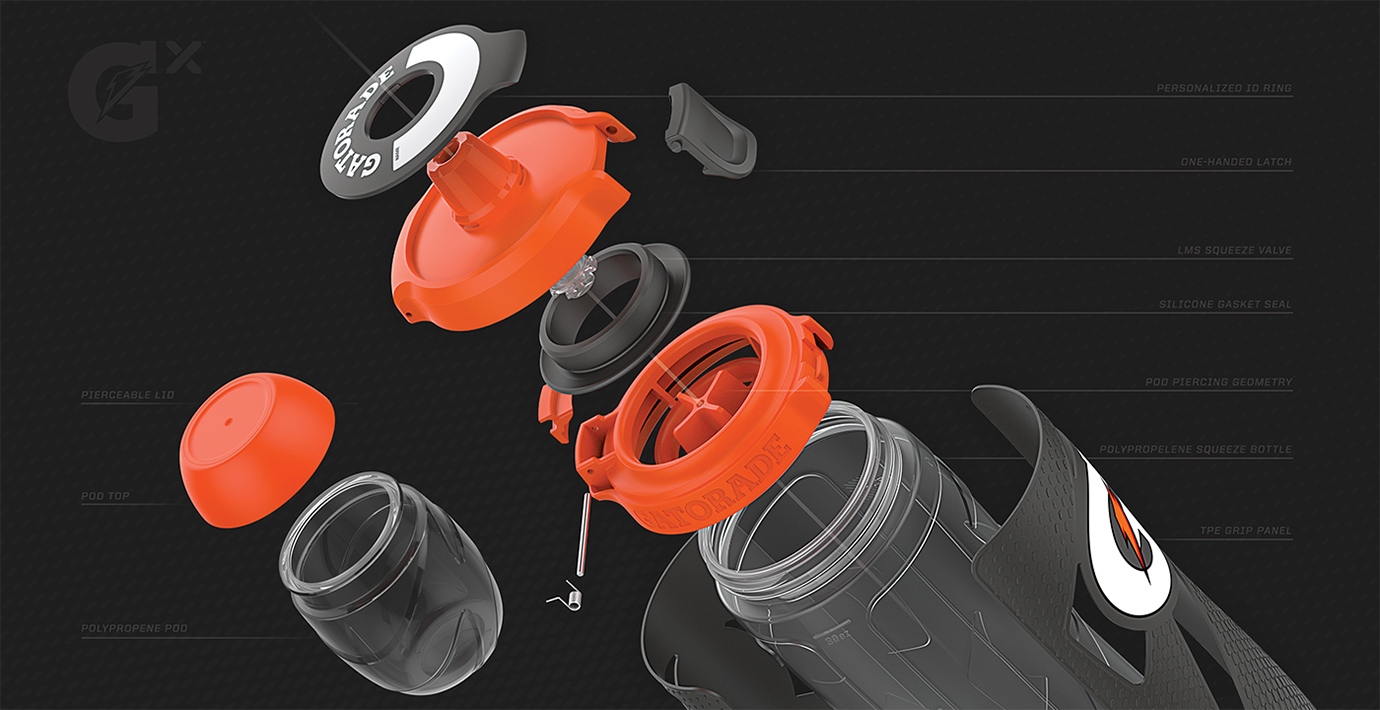
Tether approached the design as a complete system, treating hydration product design as a platform challenge rather than a single-bottle brief.
The bottle needed to feel natural across different grip conditions and athletic contexts. A football player may use it quickly between plays with gloves on. A tennis player may reach for it bare-handed during a changeover. A runner, trainer or team athlete may use it in a completely different rhythm. The form had to support those different behaviors without becoming complicated.
The Gx pod system added another layer. The concentrated formula pod had to attach cleanly, pierce reliably and mix visibly with water inside the bottle. That meant the cap, pod cradle, piercer and bottle architecture all had to work together. Personalization could not feel like an add-on. It had to be built into the structure and experience of the product.
The result was a hydration platform that made customization feel simple, physical and ownable. The design helped turn a functional act — mixing and drinking — into a branded ritual athletes could understand immediately.
Tether also partnered with Gatorade on the redesigned Dunk and Huddle Coolers, building on one of the most recognizable product ecosystems in sports.
The assignment was bigger than updating a cooler. These products had to work on professional and collegiate sidelines, support trainers and teams during active play, perform at retail and carry a visual identity worthy of the Gatorade brand.
Durability was essential. The coolers needed to hold up to repeated transport, weather exposure, field impact and daily use, while staying practical to move, open, refill and clean. Every touchpoint mattered: the handles, the latch, the lid, the spigot, the body structure and the way the brand appeared on the product.
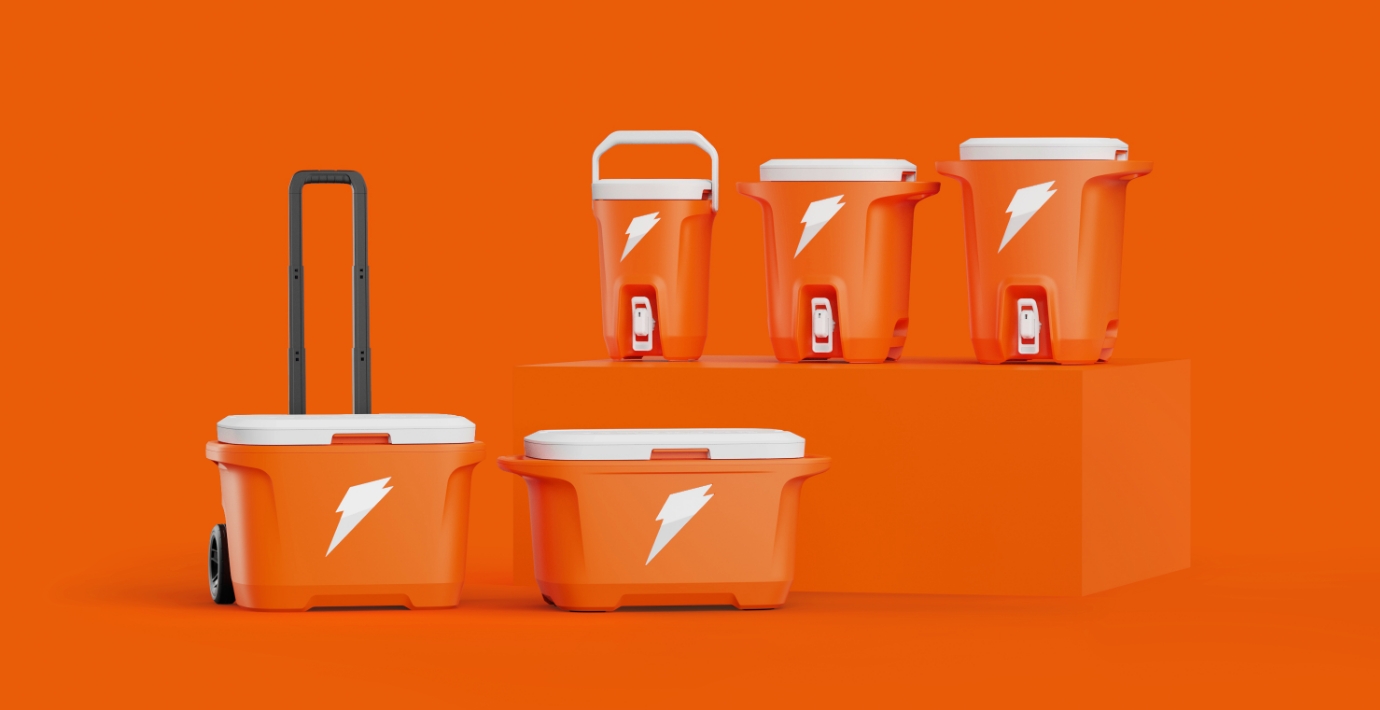
The Quick-Snap latch system was designed for fast, reliable access. Trainers do not have time to fight with equipment during a game or practice. The latch needed to feel secure in transport and easy to operate in the flow of use.
The redesigned rocker spigot improved the hydration experience by delivering a consistent stream while giving users more control. It also needed protection from the realities of the sideline, where products are moved quickly and often handled roughly.
Branding became part of the product architecture as well. Instead of relying on sticker-based logos that can peel, fade or wear down, the redesigned coolers used molded-in branding. That choice made the identity more durable and more integrated, while giving the product a more permanent, premium presence.
And because the Gatorade cooler is part of sports culture, the dunk itself mattered. Lower handles made lifting and pouring easier, protecting the ritual while improving the experience around it.
The result was a product family designed for performance, retail presence and brand memory at the same time.
See the Gatorade Dunk & Huddle Coolers Project
A strong sports product design partner should be able to do more than create a compelling concept image. Renderings are useful, but they are only one step in the process. The real test is whether the idea can move through prototyping, manufacturing and repeated use without losing what made it strong in the first place.
When evaluating a design partner, look for a team that understands the full path from insight to production. That includes user research, concept development, prototyping, material exploration, mechanical problem solving, vendor collaboration, tooling support and brand integration.
Ask how they prototype. Ask how they test. Ask how they work with engineers, manufacturers and internal teams. Ask whether they can protect the design intent when production realities start to put pressure on the idea.
The best partners treat performance product design and brand expression as one problem, not two. They can make a product feel intuitive in the hand, strong in the field, efficient to manufacture and unmistakably connected to the brand.
That combination matters. In sports, products are not experienced in isolation. They show up in the locker room, on the sideline, in retail, in the hands of athletes and in the rituals fans remember. A good product can solve a practical problem. A great one can become part of the story of the sport.
Sports product design is where performance, brand, manufacturing and real-world use come together. The details are practical: grip, flow, insulation, durability, cleaning, transport, storage and cost. But the outcome is bigger than the object itself.
The right product can make an athlete’s routine easier. It can help a trainer move faster. It can make a brand more visible, more trusted and more memorable in the moments that matter.
At Tether, we design sports products as complete systems: physical, functional, emotional and commercial. We bring together industrial design, brand thinking and real-world execution to create products that feel natural in use and meaningful in context.
If you are building a sports product that needs to perform in the field, carry the brand and make it through manufacturing with the idea intact, we would welcome the conversation.
Share » the » story


